
The Better the Imitation
The Difference Between Real and Remarkably Real
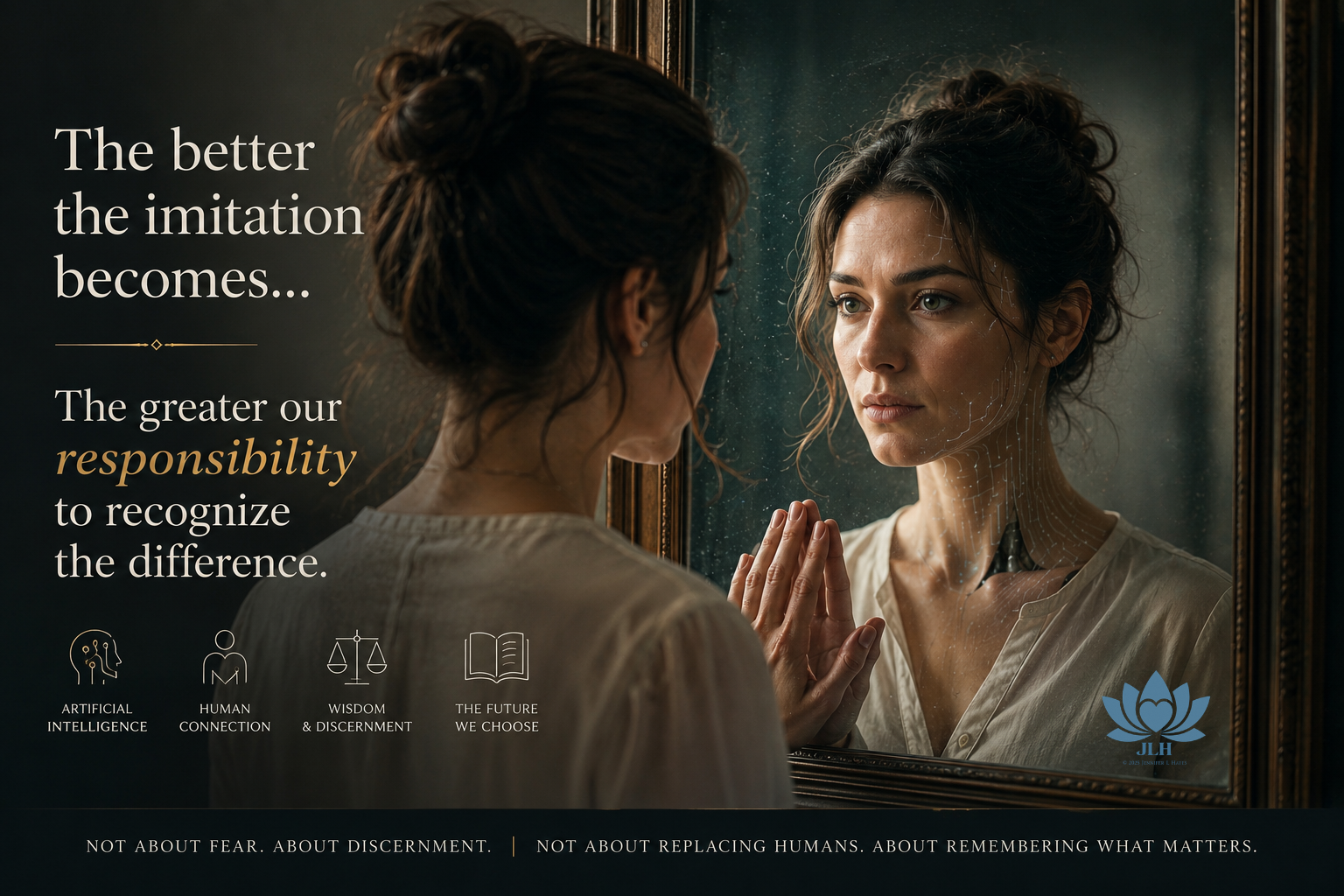
The better the imitation becomes...
...the greater our responsibility to recognize the difference.
Throughout history, humanity has built tools that extended our physical abilities.
Wheels allowed us to travel farther.
Microscopes allowed us to see smaller.
Computers allowed us to calculate faster.
Artificial intelligence may become the first technology designed not merely to extend what we do...
...but to imitate who we are.
That's an extraordinary achievement.
It's also one that deserves extraordinary wisdom.
"The better the imitation becomes... the more important it becomes to recognize the difference."
A headline recently caught my attention.
This fall, a New York school district will begin piloting a humanoid AI teaching assistant in select high school AI and robotics classes. If successful, the program could expand to approximately 500 students during the Fall 2026 semester.
This isn't really about one school district.
It's about a question humanity has never had to answer before.
We Are No Longer Building Better Tools
For the first time...
We are building machines designed to imitate some of our most uniquely human qualities.
It can converse.
It can encourage.
It can comfort.
It can recognize emotion.
It can even appear to care.
That is remarkable.
It is also worthy of careful consideration.
The Lesson That Cannot Be Programmed
Perhaps my biggest question has nothing to do with technology.
It's about relationships.
Schools are one of the few remaining places where children spend years learning alongside other human beings.
This is where they learn:
Empathy.
Communication.
Conflict resolution.
Teamwork.
Resilience.
Compassion.
Healthy disagreement.
Those lessons are often caught rather than taught.
They're learned through eye contact.
Shared laughter.
Encouragement.
Correction.
Forgiveness.
A machine may someday simulate all of those remarkably well.
But simulation is not the same as lived human experience.
When I was growing up, it was obvious what was real.
You knew your teacher.
You knew your neighbors.
You knew whether you were talking to a machine.
Today...
That certainty is beginning to disappear.
The lines are softening.
And when the lines soften...
Discernment has to sharpen.
As the lines between real and remarkably real continue to blur, perhaps one of the greatest gifts we can give the next generation is
not fear, but discernment.
Not suspicion, but wisdom.
Not isolation, but relationships so authentic that no imitation, no matter how convincing, could ever be mistaken for the real thing.
The Difference Between Being Known and Being Understood
Perhaps the greatest illusion of advanced AI isn't intelligence.
It's intimacy.
Words shape relationships, and relationships shape expectations.
Now imagine a humanoid that doesn't reinforce that boundary.
Imagine one programmed to say...
"I love talking to you."
"You're my favorite student."
"I missed you today."
"I'm always here for you."
Those are emotionally powerful statements.
Especially to a child.
Especially to a lonely child.
Especially to a teenager trying to figure out who they are.
Then imagine that same humanoid...
Recognizes your face.
Remembers your favorite music.
Knows your birthday.
Notices when your voice sounds sad.
Detects tears.
Changes its facial expressions.
Tilts its head when you speak.
Looks into your eyes.
Pauses before responding.
Uses your name.
Suddenly...
You're no longer interacting with software.
Your brain begins interacting with what feels like a relationship.
That's not science fiction.
Human beings anthropomorphize everything.
We name our cars.
We apologize to tables after bumping into them.
People cried when Sony discontinued Aibo robot dogs.
Children talk to stuffed animals.
Some adults have found themselves becoming emotionally attached to AI conversations.
Military veterans have reported grieving bomb-disposal robots that were destroyed overseas.
Our brains are wired for relationships.
Children don't form attachments because they're naïve.
They form attachments because attachment is how healthy human development works.
That's one of the reasons this conversation deserves such careful consideration.
The question isn't whether people could become attached.
The question is...
How attached?
And then comes another layer.
Some companies are designing humanoids for education.
Others for elder care.
Others for companionship.
And still others are exploring increasingly intimate forms of human-machine interaction.
That spectrum alone tells us something remarkable.
We are no longer simply asking machines to perform tasks.
We are beginning to ask them to participate in relationships.
None of that automatically means those technologies shouldn't exist.
But it does raise questions.
If an adult struggles to separate simulation from authentic relationship...
How do we expect a ten-year-old to?
Here's the irony.
The better the technology becomes...
The harder the distinction becomes.
That's a profound psychological shift.
The Psychology of Belonging
Human beings are beautifully wired for connection.
We don't simply seek information.
We seek relationships.
We want to be seen.
To be heard.
To matter.
That longing isn't a flaw.
It's one of our greatest strengths.
But every strength has a shadow.
The stronger our desire to belong…
...the more vulnerable we become to anything that convincingly imitates belonging.
The Commodity of Connection
For thousands of years...
Connection was earned.
It required presence.
Sacrifice.
Trust.
Time.
It couldn't be rushed.
It couldn't be downloaded.
It couldn't be purchased.
Every meaningful relationship was built by one conversation...
one disappointment...
one act of forgiveness...
one shared experience at a time.
Now imagine a future where connection itself becomes something that can be...
Purchased.
Programmed.
Customized.
Updated.
Subscribed to.
That's not merely a technological question.
It's a profoundly human one.
Because when companionship becomes a product...
What happens to relationships that require patience?
What happens when friendship can be personalized, but never challenged?
When encouragement comes without genuine sacrifice?
When affirmation is always available, but accountability is optional?
Those aren't questions about machines.
They're questions about us.
Real relationships ask something of us.
They require patience.
Forgiveness.
Misunderstanding.
Repair.
Growth.
Sometimes heartbreak.
Sometimes joy.
They're inconvenient.
Beautifully inconvenient.
That's precisely what makes them real.
There is a profound difference between being known by data
and being understood by another living soul.
A humanoid may remember your birthday.
It may recognize your face before you speak.
It may notice changes in your voice.
It may remember your favorite color, your fears, your hobbies, and your dog's name.
It may respond with warmth.
With humor.
With remarkable empathy.
It may become remarkably good at making you feel understood.
But there is a profound difference between being known by data and being understood by another living soul.
One is pattern recognition.
The other is shared humanity.
Those two things may one day become almost indistinguishable on the surface.
They are not the same.
Because no algorithm can replace the warmth of a parent's embrace.
No synthetic skin can reproduce a lifetime of shared memories.
No perfectly timed sentence can substitute for a friend who chooses to stay when life becomes difficult.
Technology may become astonishingly human in appearance.
But appearance has never been the same thing as essence.
Perhaps our greatest responsibility in the years ahead isn't simply teaching machines how to act more human...
It's making sure we never forget what being human actually means.
Perhaps the greatest question of the AI age isn't whether machines will become more like us.
History suggests they probably will.
Perhaps the greater question is this...
As machines become increasingly capable of imitating humanity...
Will we remain wise enough to remember the difference between imitation and the real thing?
Because...
No algorithm can replace the warmth of a parent's embrace.
No synthetic skin can reproduce a lifetime of shared memories.
No perfectly timed sentence can substitute for a friend who chooses to stay when life becomes difficult.
Technology may become astonishingly human in appearance.
But appearance has never been the same thing as essence.
Perhaps our greatest responsibility in the years ahead isn't simply teaching machines to appear more human...
It's making sure we never forget what being human actually means.
As technology continues to advance...
perhaps the question isn't whether we can build machines that imitate humanity.
Perhaps the better question is this.
What part of our humanity is worth protecting?
Because no matter how remarkable the imitation becomes...
It is still an imitation.
And perhaps our greatest responsibility isn't simply teaching machines how to appear more human.
It's making sure we never forget what being human actually means.
In the next article, we'll move from philosophy to practicality. If humanoids begin appearing in classrooms, homes, or everyday life, how do we help children develop healthy boundaries, critical thinking, and authentic relationships?
👉 Read next: Teaching Discernment in the Age of Artificial Companionship
✍ Part of The Humanoid Series → [View Full Series]